Shining a Light on Solar Panels

Using solar energy to power your home can be a great way to both help fight climate change and save money by lowering your electric bill.

m_FRS102307.jpg

An energy source for decades, solar panels can be found on residential and commercial rooftops, city and county roadside signs, in stadiums and on spacecrafts. Solar panels work by taking the sun’s energy and changing it into electricity. Comprised of many individual cells typically made from silicon (a semiconductor most commonly known for its use in computers), the silicon cells, when exposed to sunlight, generate electricity in a process known as the “photovoltaic effect.”

We’ve been experimenting with the photovoltaic process for almost two centuries. The photovoltaic effect—first documented by French physicist Edmond Becquerel in 1839—is the generation of voltage and electric current in a material upon exposure to solar radiation. In most photovoltaic usages the radiation is sunlight and the devices are called solar cells. The sun is basically a nuclear reactor. It releases small bits of energy called photons. These photons then travel 93 million miles from the sun to Earth in under 9 minutes. The sun emits enough photons in one hour to generate enough power to meet current global energy requirements for an entire year. I’d say that’s a great resource.

To harness that resource for our home, a collection of solar panels are installed on the roof. The solar cells absorb the energy from the sunlight and electrons begin to flow and generate an electric current. Electrical wires capture the current from each panel and combine it with the current from the other panels. This initial current is DC, direct current. Since all of the appliances, lights and equipment in our home use AC alternating current to operate, a device called a solar inverter is used to convert the DC current to AC current. The wires then take the collected DC current to the inverter and additional wires take the AC current out of the inverter and into our electrical panel to power our home. If our home produces more power than we need, the surplus energy gets sent back to the power grid and we get credit on our bill. This process of giving power back is called Net Metering.

If you’re interested in adding solar power to your home for cleaner energy and financial benefit, it is recommended that you do some research and consider all of your options. Contacting your power company, getting quotes from multiple installers, and talking with you neighbors, especially those who have installed solar panels, are a few of the things you can do. Good luck and keep your sunny side up!

—Leslie Chew, Force For Good Technical Advisor


Celebrities Can Be Heroes - Russell Westbrook

Russell Westbrook: #Whynot Be a Force For Good

Born in Long Beach, California, 31-year-old Russell Westbrook is an amazing basketball player. Westbrook began to develop his game at Leuzinger High School in Lawndale, California, and went on to play for the UCLA Bruins in Los Angeles where, in his second season, he became the Pac-12 Defensive Player of the Year. After only two years at UCLA, Westbrook entered the NBA draft and was selected 4th overall by the Seattle Supersonics. Just six days later, the team moved to Oklahoma City and changed their name to the Thunder. After 11 seasons in Oklahoma, this All-Star now plays for the Houston Rockets.

Yes, this nine-time NBA All-Star earned the NBA Most Valuable Player Award in the 2016–17 season; he’s an eight-time All-NBA Team member; and he led the league in scoring in 2014-15 and 2016-17. And, if that’s not enough proof positive, Westbrook won back-to-back NBA All-Star Game Most Valuable Player awards in 2015, ’16 and ’17. 

But here’s the real magic of Russell Westbrook: Selflessness. Westbrook became one of only two players in NBA history to average a triple-double for a single season. (The other player was Oscar Robertson in 1962.) Sidebar for a quick sports lesson: a triple-double is when a player accumulates ten or more (a double-digit total) in three of five statistical categories (points, rebounds, assists, steals, or blocked shots) in a single game. The most common combination is points, rebounds and assists. Besides setting a record for the most triple-doubles in a season with 42, Westbrook went on to average a triple-double the following two seasons, led the league in assists, and became the first player to lead the league in points and assists in multiple seasons. He is currently second in NBA history, behind the legendary Oscar Robertson, in career triple-doubles. His ability to score points—and more importantly, to assist his fellow players to score points—is his superpower.

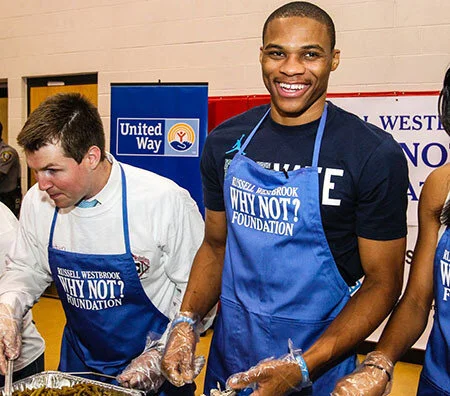
But Westbrook’s selflessness is not limited to the basketball court. Off the court, he has created the Why Not? Foundation. Founded in 2012, the mission of the Russell Westbrook Why Not? Foundation is “to inspire the lives of children, empower them to ask ‘Why not?’ and teach them to never give up.”

In addition to donating and raising funds, Russell Westbrook is in the community being a Force For Good, creating Russell Reading Rooms in elementary schools and hosting community Thanksgiving dinners, Christmas gift parties for the underserved, and basketball camps. He joins other forces for good to support and promote job skills for at-risk young adults, clothing donations, and children’s rehabilitation centers. And for all of Westbrook’s good work, we see him to be a hero by example, not just by celebrity. 

For more information, visit whynotfoundation.org.

—Hillary Black, Force For Good Editor

California Sound
Thank You, Gloria Steinem

“The future depends entirely on what each of us does every day; a movement is only people moving.” —Gloria Steinem

“Gloria will be here today.” Gloria! I was fresh out of college where I studied theater arts and helped get Equal Rights Amendment petitions signed. Now here I was, working on a TV movie about feminist icon Gloria Steinem. Yes, that Gloria. My sister and I were huge fans thanks to my mom’s introduction. Her—and Dad’s—matter-of-fact attitude about equality included “You can do anything you put your mind to,” said with gusto, confidence, and unconditional love (although a detailed map along with that mantra sure would have helped). But the logical, commonsense side of me got it—not as via osmosis but, well, like: of course we are equal and can do anything! And for all to hear that message, Gloria gave her voice and more, more, more. 

I’ve always loved the fact that our March birthdays are just a day (and a few decades) apart. The Gloria in our movie, A Bunny’s Tale, was not far from my age at the time although I don’t remember making that connection then. A young journalist, Gloria Steinem went undercover as a Playboy Bunny and wrote an expose for the now-defunct Show magazine. It was critical to attack this chapter of her life with deserved sensitivity and dignity. Our team worked hard to honor her, from initial contracts to final shot.

If you’ve ever met one of your heroes, you may know the feeling. If you’re like me, you want to keep shut so you don’t say anything stupid, show respect by staying cool like everything is normal. But of course, it’s not. So at the same time, you want to scream out how wonderful she is, how lucky we are to have her, shout “thank you for all of your hard work and inspiration on our behalf!”

That day, she graciously inscribed her new book for me to give to my mother. Now a bestseller, Outrageous Acts and Everyday Rebellions was a big deal—it was like having Gloria’s golden words all to yourself. I was so proud: to have had the pleasure to be in her company, to have helped bring her story to light, and then to bring that book to my mom, with words to her in fresh ink from Gloria’s hand.

For Gloria Steinem’s most recent book, The Truth Will Set You Free, But First It Will Piss You Off!, go here.

—Hillary Black, Editor, Force For Good